
Emergency donations consistently surge during moments of crisis—natural disasters, humanitarian emergencies, public health events, and sudden community needs. For churches and nonprofits, understanding why emergency donations increase and how digital tools like mobile giving enable faster responses is critical to meeting urgent needs effectively.
Whether it’s an earthquake, flood, or local community emergency, people tend to give more—and give faster—when urgency, emotion, and accessibility intersect. This behavior isn’t random; it’s driven by psychology, trust, and technology working together in real time.
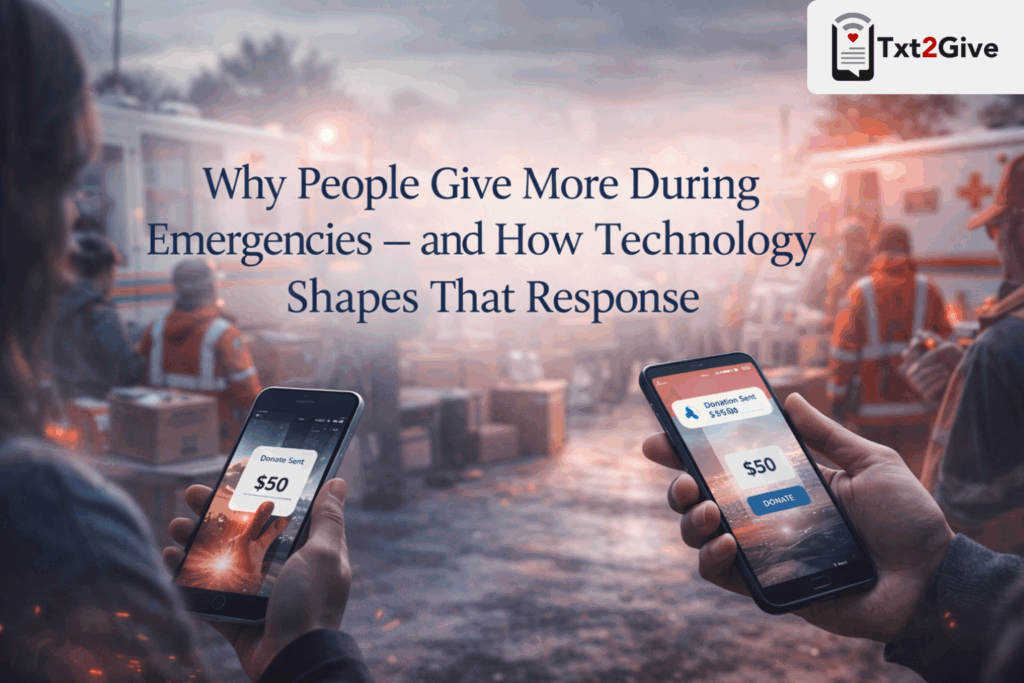
In normal circumstances, people often intend to give but delay action. Emergencies remove that delay.
Psychologists call this the urgency effect: when a situation feels time-sensitive, people prioritize immediate action over long-term planning.
Emergency donations work because:
The need is clear and immediate
The consequences of inaction feel tangible
The decision feels morally pressing
This urgency short-circuits hesitation.
Emergencies are emotionally vivid.
Images, stories, and firsthand accounts activate empathy far more effectively than abstract causes. Research in behavioral science shows that people are more likely to give when they can emotionally visualize the impact of their donation.
This is known as the identifiable victim effect—people respond more strongly to specific, human-centered stories than general statistics.
During emergencies, people often see:
Friends sharing donation links
Churches making appeals
Organizations posting real-time updates
Public donation counters increasing rapidly
This creates social validation—a powerful motivator that reinforces giving behavior.
People subconsciously think:
“Others are helping. I should help too.”
Technology doesn’t create generosity—but it removes friction, making generosity easier to act on.
During emergencies, motivation is fleeting. If people can’t give quickly, intent disappears.
With digital tools like mobile giving, donors can:
Give immediately after seeing an appeal
Act while emotional connection is strongest
Most emergency donation behavior now begins on mobile.
According to research by Pew Research Center, mobile devices are the primary way people consume breaking news and crisis updates.
Technology allows:
First-time donors to participate easily
Smaller donations to be made quickly
Wider geographic reach during crises
This is why emergency campaigns often see an influx of new donors, not just existing supporters.
In normal fundraising, donors often evaluate:
“Is this the right cause?”
“Is my gift enough?”
“Can I afford this now?”
During emergencies, these questions fade. Giving feels less optional and more necessary.
People give more because:
The moral clarity is stronger
The perceived impact feels immediate
The cause feels non-negotiable
Emergency donations come with clear expectations:
Food for families
Shelter for displaced people
Medical aid for urgent care
When donors understand exactly what their money supports, they give more confidently.
In emergencies, donors prioritize trust over optimization.
They ask:
“Is this organization credible?”
“Will the funds be used quickly?”
“Is this appeal transparent?”
Organizations with established credibility see significantly higher average donation amounts during crises.
Technology allows organizations to provide:
Live progress updates
Clear fund usage explanations
Post-emergency impact reports
Research from Charity Navigator shows that transparency directly affects donor trust and repeat giving—especially during crisis campaigns.
Not all emergency appeals are equal.
Responsible organizations:
Avoid exaggeration or fear-based messaging
Provide accurate information
Communicate outcomes clearly
Respect donor fatigue
Technology makes it easier to raise funds—but ethics determine whether donors return after the crisis ends.
Churches often serve as trusted community anchors during emergencies.
Emergency donations in church settings are often driven by:
Local credibility
Pastoral leadership
Community trust
Direct impact visibility
With tools like church giving platforms, churches can:
Respond quickly to local emergencies
Support global causes transparently
Allow members to give even when not physically present
One overlooked insight: emergency donors often become long-term supporters if handled well.
What matters after the crisis:
Thank-you communication
Follow-up impact updates
Clear closure messaging
Optional continued engagement (not pressure)
Emergency donations shouldn’t be treated as one-time transactions—but as the start of a relationship.
Digital tools help organizations:
Segment emergency donors
Share follow-up stories
Invite—not demand—future involvement
Platforms that integrate giving, communication, and transparency help convert urgency-driven donors into long-term supporters.
Emotion triggers action—but trust sustains it.
They do—when organizations communicate responsibly.
Speed and clarity often feel more respectful during crises.
The best time to prepare for emergency donations is before an emergency occurs.
Organizations should:
Have digital giving tools ready
Ensure donation pages are mobile-friendly
Prepare transparent messaging templates
Establish credibility early
Emergency response success is rarely improvised—it’s prepared.
People give more during emergencies because urgency clarifies purpose, emotion strengthens empathy, and technology removes barriers.
When organizations understand this intersection—and respond with transparency, ethics, and preparedness—emergency donations become not just a reaction, but a meaningful act of collective care.
Technology doesn’t replace compassion.
It enables people to act on it—when it matters most.
For long-time users of our original interface and for anyone who prefers the classic dashboard.
For accounts created after Sept 2025 and for anyone who wants to use our updated dashboard.