
Gen Z giving is reshaping how generosity works—how people give, why they give, and what they expect in return. Unlike previous generations, Gen Z doesn’t separate generosity from daily life. Giving happens quickly, digitally, and often in response to moments rather than campaigns.
For churches and nonprofits navigating this shift, understanding younger generations and giving behavior isn’t optional—it’s foundational. Digital tools like mobile giving and transparent communication have become baseline expectations, not innovations.
But Gen Z didn’t arrive at these habits in isolation. Their approach to giving reflects decades of evolving donor behavior across generations—each shaped by culture, technology, and trust.
To understand Gen Z, we need context.
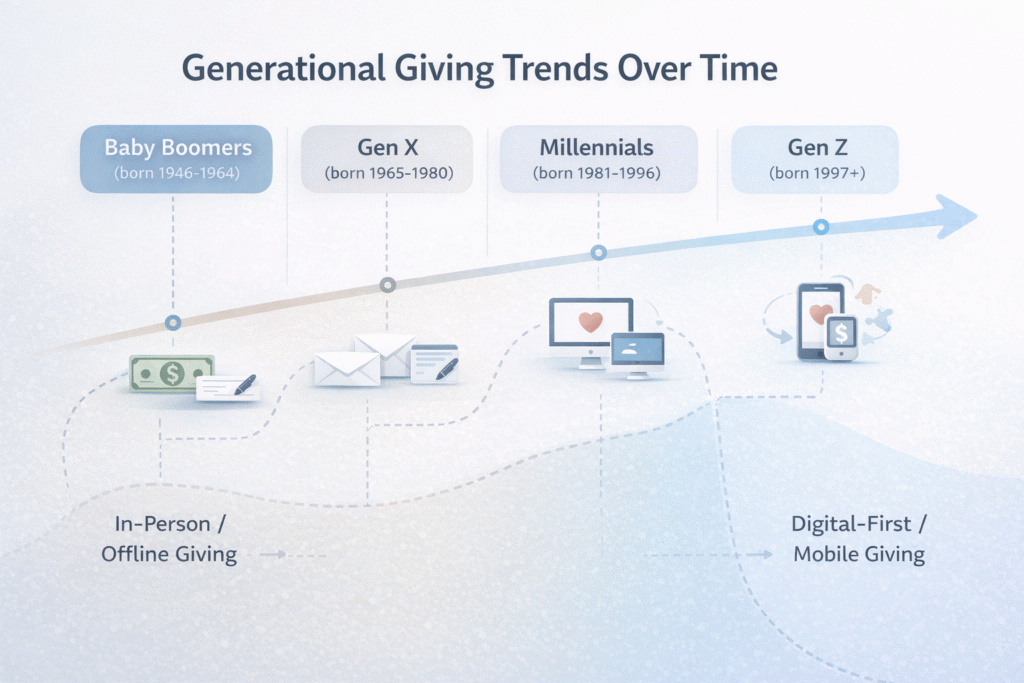
Boomers grew up in an era of strong institutional trust. Their giving patterns tend to reflect:
Long-term loyalty to organizations
Larger, less frequent donations
Preference for in-person or traditional channels
For many nonprofits, Boomer donors formed the backbone of annual fundraising for decades.
Gen X donors became more skeptical of institutions and more focused on outcomes. Their giving behavior reflects:
Support for specific causes, not just organizations
Increased interest in accountability
Gradual adoption of online giving tools
They bridged the gap between traditional and digital generosity.
Millennials marked a major shift. They:
Normalized online and mobile donations
Expected alignment with personal values
Responded strongly to storytelling and social proof
However, Millennials still often view giving as something they plan—monthly donations, campaigns, or annual drives.
Gen Z takes this one step further.
Gen Z responds in real time. When they feel moved, they act—often instantly.
They are more likely to:
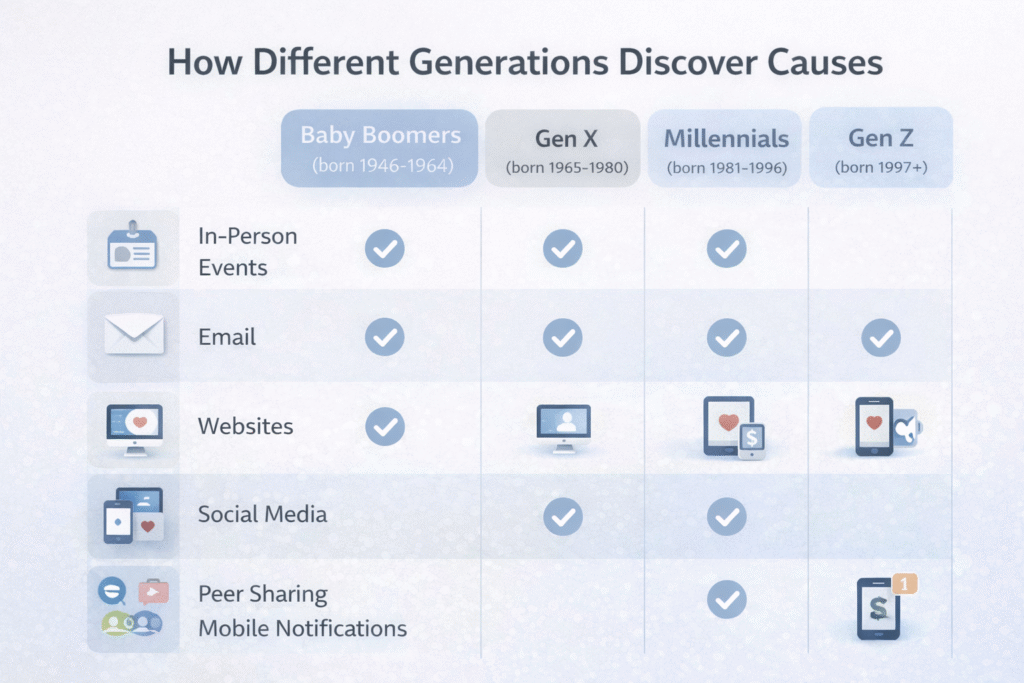
Donate after seeing a story or post
Give in smaller amounts, more frequently
Respond to urgency rather than annual appeals
This makes ease of access critical. Friction reduces follow-through dramatically.
Unlike older generations, Gen Z does not assume credibility based on longevity.
They want:
Clear explanations of where funds go
Visible impact updates
Honest communication—even when outcomes aren’t perfect
According to research from the Pew Research Center, Gen Z consistently ranks transparency and authenticity higher than institutional authority when deciding whom to support.
Gen Z is comfortable with modest financial contributions—especially when combined with:
Sharing content
Advocating socially
Participating in community action
They don’t measure generosity by dollar amount, but by participation.
This aligns with the rise of micro-donations, recurring giving, and rapid-response generosity models.
Technology doesn’t just enable Gen Z giving—it defines it.
With digital giving tools, Gen Z donors expect:
Mobile-first experiences
Instant confirmation
Seamless, intuitive design
No unnecessary steps or forms
If giving feels outdated, complicated, or unclear, they disengage quickly.
This isn’t impatience—it’s expectation shaped by digital life.
Gen Z is heavily influenced by:
Peer behavior
Social validation
Shared causes within online communities
They are more likely to give when:
Friends are involved
A cause is trending for a reason
They see real people—not institutions—taking action
This makes community-driven giving more effective than top-down appeals.
A common misconception is that Gen Z lacks loyalty.
In reality, they are:
Less loyal to institutions
More loyal to values and impact
If an organization:
Communicates clearly
Responds quickly
Shows real outcomes
Gen Z stays engaged—often longer than expected.
If it doesn’t, they move on without friction.
For churches, Gen Z giving reflects a broader shift in participation.
Younger members:
Give digitally even when not physically present
Prefer flexibility over obligation
Respond to mission clarity more than tradition
Offering options through donations pages and mobile tools allows churches to meet Gen Z where they are—without pressure or guilt-based messaging.
For nonprofits, this shift means:
Less reliance on single large donors
More emphasis on consistent engagement
Greater need for storytelling and transparency
Importantly, Gen Z giving doesn’t eliminate traditional generosity.
Instead, it:
Broadens participation
Reduces dependence on seasonal campaigns
Creates resilience through diversity of support
Organizations that adapt don’t lose older donors—they gain younger ones.
Gen Z is shaping the future of generosity by normalizing:
Everyday giving
Digital-first generosity
Values-led participation
As they gain financial stability over time, these habits will scale.
According to the Stanford Social Innovation Review, early engagement is one of the strongest predictors of long-term donor retention—regardless of initial donation size.
Gen Z giving isn’t a trend—it’s a signal.
It reflects a broader cultural shift toward immediacy, transparency, and participation. Organizations that listen, adapt, and simplify the giving experience will not only reach younger donors—but build stronger, more resilient communities.
The future of giving won’t be defined by who gives the most—but by who gives consistently, confidently, and with purpose.
For long-time users of our original interface and for anyone who prefers the classic dashboard.
For accounts created after Sept 2025 and for anyone who wants to use our updated dashboard.