
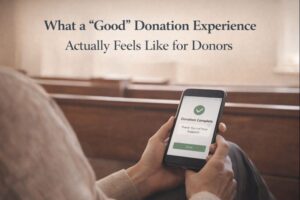
Most donors don’t remember the exact amount they gave.
They remember how the experience felt.
Whether a donation was made during a church service, at a community fundraiser, or through an online donations page, the emotional experience shapes whether a donor gives again. This is where donor experience design becomes critical.
A good donation experience doesn’t feel impressive or complex. It feels clear, calm, and respectful.
Donor experience design focuses on how people experience giving — before, during, and after a donation.
It includes:
Ease of donating
Emotional reassurance
Clarity of purpose
Respect for time and attention
Follow-up communication
Design isn’t just about screens. It’s about how supported donors feel throughout the journey.
Every donation follows a simple emotional arc:
Motivation — “I want to help.”
Decision — “This feels meaningful.”
Action — “I’ll give now.”
Reassurance — “Did it work?”
Reflection — “Was it worth it?”
A good donor experience design supports each of these moments.
When even one step feels confusing or stressful, donors hesitate.
From a donor’s perspective, a good experience feels:
Effortless, not demanding
Clear, not cluttered
Reassuring, not uncertain
Respectful, not transactional
Donors should never feel rushed, confused, or pressured.
Complex donation forms are one of the most common experience killers.
Good donor experience design prioritizes:
Fewer fields
Clear language
Obvious next steps
Mobile-friendly layouts
Donors shouldn’t have to “figure out” how to give.
Many donations happen in moments — during a service, after reading a story, or while attending an event.
If the mobile giving experience feels broken, donors often abandon the process.
A strong mobile experience:
Loads quickly
Requires minimal typing
Works smoothly across devices
You can also learn from : Designing Better Donation Experiences for Nonprofits
Donors want to feel safe — emotionally and practically.
This means:
Clear confirmation messages
Visible trust signals
Transparent language
No unexpected steps
Uncertainty creates anxiety. Anxiety stops generosity.
One of the most underrated parts of donor experience design is what happens after the donation.
A good experience includes:
Immediate confirmation
Clear receipt or acknowledgment
Reassurance that the gift was successful
Even a simple message can dramatically improve confidence.
Donation experiences at events should feel seamless — not disruptive.
Good event design ensures:
Clear instructions
Easy access to giving
Minimal interruptions
When giving feels natural within an event, participation increases.
For churches, donor experience design is deeply connected to spiritual values.
Giving should feel:
Voluntary
Respectful
Aligned with faith and stewardship
Good design reinforces generosity without pressure.
Seemingly small details shape how donors feel:
Button wording
Page flow
Thank-you language
Visual calm
Design is not decoration — it’s communication.
While metrics matter, donor experience is also felt, not just measured.
Organizations should pay attention to:
Abandoned donations
Repeat giving behavior
Qualitative feedback
Numbers tell you what happened. Experience explains why.
Poor experiences feel:
Stressful
Confusing
Rushed
Impersonal
Even well-intentioned donors may not return after a frustrating experience.
Good donor experience design starts with empathy.
Instead of asking:
“How can we get more donations?”
Ask:
“How does this experience feel to the person giving?”
This shift changes everything.
A good donation experience doesn’t draw attention to itself.
It quietly supports generosity.
When donor experience design prioritizes clarity, empathy, and respect, donors don’t just give — they feel good about giving. And that feeling is what brings them back.
For long-time users of our original interface and for anyone who prefers the classic dashboard.
For accounts created after Sept 2025 and for anyone who wants to use our updated dashboard.