
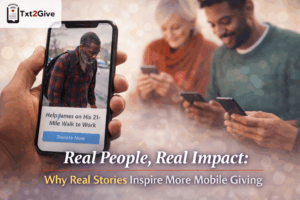
When people decide to give, they rarely do so because of spreadsheets, statistics, or broad mission statements. They give because something feels real. A face, a name, a moment — these elements turn generosity into action.
This is especially true with mobile giving, where decisions are made quickly, often in emotional moments. As more donations happen through smartphones, understanding why specific stories work has become just as important as having the right technology in place.
Researchers have long studied a phenomenon known as the “identifiable victim effect.” Simply put, people are more likely to help when they can connect their donation to a specific person or story, rather than a vague group.
A single child in need often receives more support than a general appeal to help “thousands affected.” This isn’t because people care less — it’s because the human brain processes individual stories more easily than abstract numbers.
Mobile giving amplifies this effect. When a donor receives a text, sees a post, or watches a short video on their phone, the emotional response is immediate. If the story feels personal, the action often follows instantly.
One of the most cited examples of mobile giving success is the Text-to-Haiti campaign following the 2010 earthquake. Rather than presenting abstract funding goals, early messaging focused on individual lives impacted by the disaster — families displaced, children injured, communities destroyed.
Supporters were asked to text a keyword to donate a small amount instantly. The result was extraordinary: tens of millions of dollars raised in days, much of it through first-time mobile donors.
According to a study by the Pew Research Center, three-quarters of people who donated via text had never given through mobile before, and over half made their donation the same day they heard about the campaign.
The combination of specific human impact + mobile convenience removed hesitation. Donors didn’t need time to research — the story and the action were aligned in one moment.
Specific storytelling doesn’t only work during global crises. It’s equally effective when causes are framed through real people, even in long-term initiatives.
When musician Alicia Keys promoted her nonprofit Keep a Child Alive, she didn’t rely on generalized messaging about HIV/AIDS. Instead, campaigns highlighted individual children and families receiving treatment and care.
Fans were encouraged to donate via mobile during concerts and live events. Within months, the campaign raised significant funds, proving that specific stories presented at the right moment can outperform traditional appeals. (source)
The key takeaway wasn’t celebrity influence alone — it was clarity. Donors knew who they were helping and how their contribution mattered.
Mobile giving works best when the story and the action are close together.
On a smartphone:
Attention spans are shorter
Emotional reactions are faster
Friction needs to be minimal
This makes specific stories essential. A donor reading about “families in need” may scroll past. A donor seeing a real person, a real situation, and a clear outcome is far more likely to act.
Mobile-optimized donation flows allow supporters to respond while the emotion is still present — whether they’re attending a holiday service, watching a livestream, or reading a story on social media.
Organizations that link storytelling directly to their mobile donations page often see higher conversion rates because donors don’t lose momentum.
Faith-based organizations have long understood the power of personal testimony. Today, many churches are translating that tradition into digital giving experiences.
Instead of broad appeals like “support our ministry,” successful campaigns focus on:
A family receiving emergency assistance
A youth program changing one student’s path
A local outreach effort helping named individuals
When these stories are shared during services or seasonal campaigns and paired with mobile giving options, participation increases — especially during holidays, when generosity is already heightened.
Directing supporters to a clear events or giving page ensures that stories don’t end with inspiration alone.
While specificity is powerful, it must be handled ethically. Organizations should always:
Share stories with consent
Focus on dignity, not desperation
Emphasize impact rather than exploitation
The goal is connection, not pity. Donors want to feel part of a solution — not like observers of suffering.
Platforms that support mobile giving make it easier to track impact, send follow-ups, and build long-term trust with supporters through transparency and communication.
Technology enables giving — but stories inspire it.
As mobile giving continues to grow, the organizations that succeed will be those that understand how people decide to give, not just how payments are processed. Specific, human stories create emotional clarity, and mobile tools make action effortless.
When these two elements come together, generosity isn’t delayed — it happens in the moment it matters most.
For long-time users of our original interface and for anyone who prefers the classic dashboard.
For accounts created after Sept 2025 and for anyone who wants to use our updated dashboard.