
Churches today operate in a very different environment than they did even ten years ago. Congregations expect seamless digital experiences—whether that means giving online, registering for events, receiving ministry updates on their phones, or watching services from home.
To meet these expectations, churches increasingly rely on church software to manage operations, connect with members, and support ministry programs.
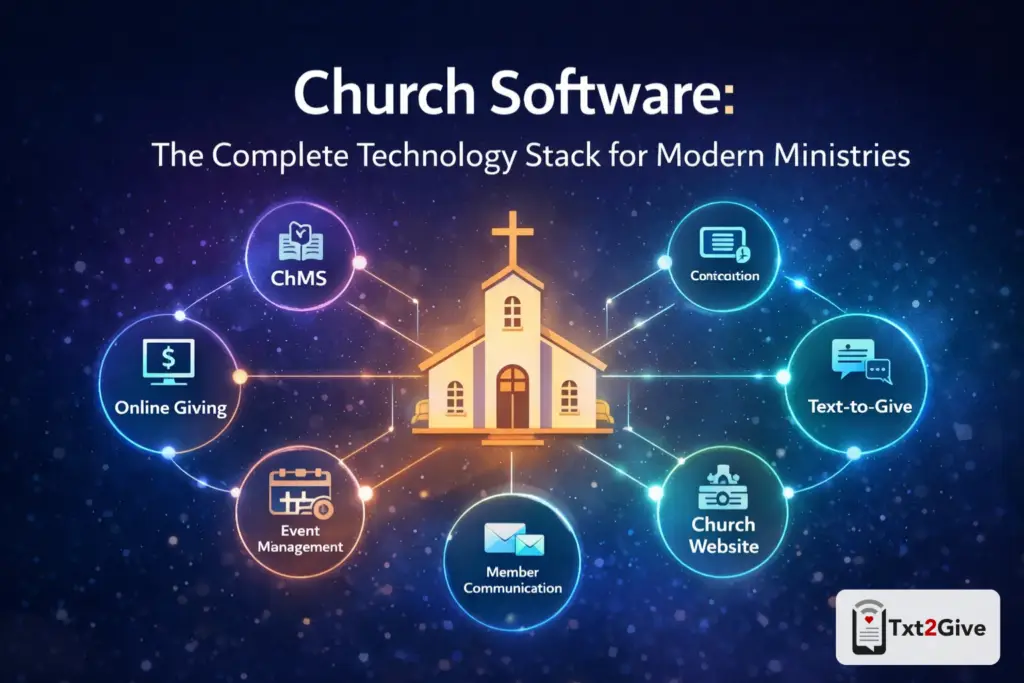
Instead of relying on spreadsheets or disconnected tools, modern churches often build a church technology stack—a collection of platforms designed to handle specific functions such as member management, donations, communication, accounting, and media.
For example, a church might use church management software (ChMS) to track members, a specialized online giving platform to process donations, and additional tools for messaging, websites, and livestreaming.
Understanding how these systems work together can help churches make better technology decisions while avoiding unnecessary costs and complexity.
If your ministry is evaluating new tools, this guide explains the most important categories of church software, what they do, and how they support healthy church operations.
Church software refers to digital platforms designed specifically to help churches manage administrative tasks, connect with members, and support ministry programs.
While different tools serve different purposes, most church software solutions help with one or more of the following areas:
Member management
Online giving and donations
Communication and messaging
Financial accounting
Event and volunteer coordination
Media and livestreaming
Together, these platforms form the digital infrastructure that supports church operations.
Research from Pew Research Center shows that digital engagement continues to shape how people interact with religious organizations. Younger generations especially expect communication, information, and opportunities to participate to be easily accessible online.
This shift has made church software an essential part of modern ministry leadership.
Most churches benefit from combining several specialized tools instead of relying on a single platform. Each category of church software serves a unique role.
Below are the most common platforms churches use today.
Church management software, often called ChMS, acts as the central database for church operations.
A ChMS platform typically helps churches manage:
member records and contact details
attendance tracking
volunteer scheduling
small group management
event registration
pastoral care notes
Examples of ChMS platforms include:
Planning Center
Breeze ChMS
Church Community Builder
These systems help churches stay organized and keep accurate member records.
However, many churches connect their ChMS with other tools such as giving platforms or communication systems to create a complete technology stack.
Online giving has become one of the most important categories of church software.
Digital donation platforms allow members to give through:
online forms
mobile apps
recurring donations
This type of church giving software makes generosity easier and more consistent.
Features often include:
automated recurring giving
reporting tools
integration with church databases
Examples include:
Tithe.ly
Pushpay
Txt2Give
Digital giving tools are especially valuable because they remove friction from the donation process and support recurring contributions.
Communication tools help churches stay connected with their congregations throughout the week.
Common features include:
email newsletters
SMS updates
event reminders
volunteer coordination
Popular platforms include:
Mailchimp
Flocknote
Church communication software helps leaders maintain engagement beyond Sunday services.
Financial transparency is critical for churches and nonprofits.
Church accounting tools help manage:
budgeting
donation tracking
expense reporting
payroll
financial statements
Common tools include:
QuickBooks
Aplos
These tools ensure accurate financial reporting and support responsible stewardship.
A church’s website often serves as the digital front door for visitors.
Church website platforms make it easier to:
publish sermons
share event calendars
accept donations
welcome new visitors
Many churches build websites using platforms such as:
WordPress
Squarespace
A well-designed website helps first-time visitors learn about your church before they attend.
Livestreaming has become a major part of modern ministry.
Church streaming tools help churches broadcast services online for members who cannot attend in person.
Popular tools include:
OBS Studio
YouTube Live
Streaming technology expands the reach of sermons, worship services, and special events.
Selecting church software requires balancing functionality, ease of use, and cost.
Before choosing platforms, church leaders should consider:
Do the tools connect with each other?
Volunteers should be able to learn the system quickly.
Look for platforms with clear pricing structures and no hidden fees.
Choose software that can grow with your congregation.
Many church leaders initially search for a single platform that does everything.
In practice, most ministries find it more effective to combine specialized tools.
For example:
ChMS + Giving Platform + Communication Tool + Accounting Software
This approach allows churches to choose the best platform for each function, rather than settling for limited features.
Church technology continues evolving as digital habits change.
Emerging trends include:
AI-powered donor insights
integrated mobile engagement
automated volunteer coordination
improved data integration between tools
As these technologies mature, churches will be able to build even more efficient ministry systems.
Church software is no longer just an administrative convenience—it’s a foundational part of modern ministry.
From church management software and online giving platforms to communication and livestreaming tools, the right technology stack helps churches stay organized, engaged, and prepared for future growth.
For church leaders evaluating new tools, the goal isn’t simply to adopt technology—it’s to build a system that supports the mission of the church and strengthens connections with the community.
Church software refers to digital tools that help churches manage members, donations, communication, events, and financial records.
Church management software (ChMS) is a platform that stores member data, tracks attendance, manages volunteers, and organizes church operations.
Many churches use specialized giving platforms that allow members to donate through online forms, mobile apps, or text-to-give systems.
Even small churches benefit from basic tools for donation tracking, communication, and member management.
For long-time users of our original interface and for anyone who prefers the classic dashboard.
For accounts created after Sept 2025 and for anyone who wants to use our updated dashboard.