
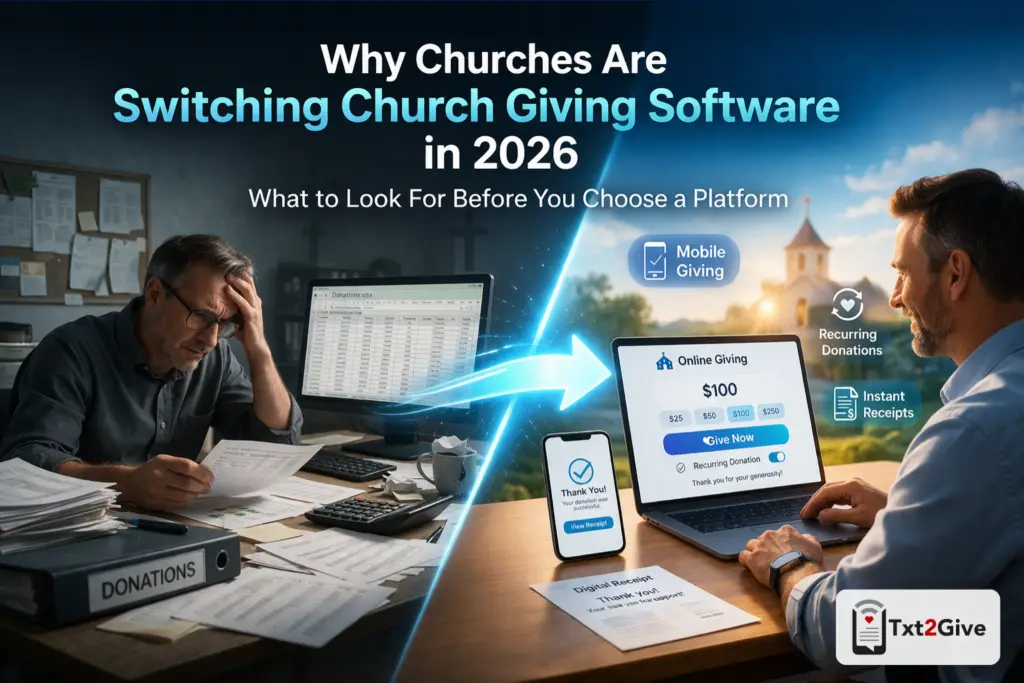
Churches today are re-evaluating how they manage donations.
What worked a few years ago is no longer enough. Congregations have changed, giving habits have evolved, and expectations around digital experiences have increased. As a result, many churches are actively reconsidering their current church giving software and exploring better alternatives.
This shift isn’t just about technology—it’s about creating a simpler, more accessible giving experience for both church staff and donors.
Church giving is no longer limited to in-person services.
Today, members expect:
the ability to give anytime, from anywhere
mobile-friendly experiences
quick and simple donation flows
flexible options like recurring giving
secure transactions for handling donations online
This shift toward online giving for churches has made software an essential part of church operations—not just a supporting tool.
Churches that fail to adapt often see:
lower participation in giving
inconsistent donations
difficulty engaging remote members
Not all platforms age well. What initially feels like a complete solution can become limiting over time.
Some platforms introduce more features over time, making them harder to use. Instead of simplifying operations, they create additional layers of complexity.
If the giving process isn’t intuitive, members are less likely to use it consistently.
Church staff often struggle with tools that require ongoing management or technical expertise.
Many churches pay for capabilities they don’t actually need.
A platform that isn’t optimized for mobile can limit engagement significantly.
Not every challenge requires a switch—but there are clear indicators when it’s worth reconsidering your current platform.
Giving participation is declining
Members find the process confusing
Staff spends too much time managing donations
Reports are difficult to generate or understand
The platform feels outdated or slow
When these issues persist, switching to a more suitable church donation platform becomes a practical step forward.
As churches reassess their tools, priorities have shifted.
Churches are moving toward platforms that are easy to use rather than packed with unnecessary features.
With more donors giving via smartphones, mobile optimization is no longer optional.
Churches want solutions that can be implemented quickly without extensive training.
A smooth giving process increases trust and encourages repeat donations.
The ability to adapt as the church grows is key.
When searching for a better solution, many churches begin by exploring alternatives to their current platform.
For example, churches that feel overwhelmed by feature-heavy systems often start looking into a Tithely alternative that focuses on ease of use and quicker onboarding.
Similarly, organizations that find enterprise-level tools too complex or resource-intensive may consider a Pushpay alternative that delivers essential functionality without unnecessary overhead.
The goal isn’t just to switch platforms—it’s to find a solution that aligns with how your church actually operates.
Choosing the right church giving software requires a clear understanding of your church’s needs.
Different churches require different levels of functionality.
A platform should be intuitive for both staff and donors.
The easier it is to give, the more likely members are to contribute consistently.
Look for solutions that don’t require extensive technical knowledge.
Choose a platform that will continue to meet your needs as your church grows.
Understand why you’re making the change.
More features don’t always mean better outcomes.
Adoption improves when members are informed and guided.
Take time to implement the new system properly.
Looking ahead, digital giving for churches will continue to evolve. Nonprofits are increasingly investing in digital tools to improve engagement and operations.
Key trends include:
increased use of mobile and text-based giving
greater automation in reporting and receipts
simplified platforms focused on usability
improved donor engagement tools
Churches that embrace these changes are better positioned for sustainable growth.
Churches are no longer just adopting digital giving—they’re refining it.
As expectations grow and technology evolves, choosing the right church giving software has become essential. The focus is shifting from feature-heavy platforms to solutions that prioritize simplicity, accessibility, and real-world usability.
By understanding what to look for—and what to avoid—churches can make informed decisions that support both their operations and their community.
Many churches are switching to improve ease of use, increase donor participation, and simplify operations.
Key factors include simplicity, mobile accessibility, recurring giving options, and ease of setup.
With proper planning and communication, the transition can be smooth and beneficial.
While software alone isn’t the only factor, a better giving experience often leads to more consistent contributions.
For long-time users of our original interface and for anyone who prefers the classic dashboard.
For accounts created after Sept 2025 and for anyone who wants to use our updated dashboard.